Women and Gender in Postwar Europe by Joanna Regulska Bonnie G. Smith
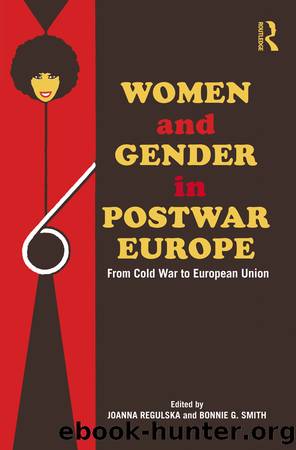
Author:Joanna Regulska, Bonnie G. Smith [Joanna Regulska, Bonnie G. Smith]
Language: eng
Format: epub
ISBN: 9781136454806
Barnesnoble:
Publisher: Taylor & Francis
Published: 2012-03-12T00:00:00+00:00
7
Happy Motherhood and Lesbian Spaces
Womenâs Initiative and the Sexual Mores of Postwar Europe
Cynthia Kreisel
Women in post-World-War-II Europe lived in societies that sought desperately to return to a prewar sense of normalcy and calm. In order to stabilize the postwar world, many European countries experienced a postwar backlash, which attempted to return women to their homes and into contrived roles of domestic tranquility after their heavy and essential participation in the Allied war movement. This return to traditionalism greatly affected womenâs ability to control their sexual and reproductive lives. For instance, in both France and Italy abortion and advertising for birth control were illegal in the 1950s and 1960s.1 In Germany, the politics of postwar occupation and the Cold War also greatly influenced womenâs reproductive options. In the Soviet Union, debates about birth control and abortion centered primarily on their harmful effects on the state. Meanwhile, some European countries followed a different path. Some took advantage of scientific improvements in birth control in order to ensure the health of their female citizens; others legalized same-sex relationships; while still others granted women access to abortion.
The ambiguous nature of sexual behavior and values in postwar Europe becomes especially clear in France, where there existed multiple sexual and reproductive regimes. A woman from an eastern European country explained that she had immigrated to France in the postwar period because she knew early on that she liked women and that same-sex love was not possible in her own country. She stressed, âFrance represented a country that was liberated in terms of its mores.â2 The French are said to have invented the art de lâamour (of love); however, in post-World-War-II France the reality of French sexuality in everyday practice was often far removed from this image. On the one hand, there was the hyper-sexualized France of the Place Pigalle, with its prostitutes, sex shows, and famous cabarets like the Moulin Rouge.3 This was the France that foreign tourists visited in order to âwalk on the wild sideâ and see âdevianceâ under the cover of darkness in certain Parisian neighborhoods. On the other hand, a great number of women in France were by no means âsexually liberated.â Instead, they were largely occupied with concerns about feeding and sheltering their families, and raising well-developed and âdignifiedâ children in the adverse postwar conditions. There were many women in France who were boldly heterosexual and applied themselves whole-heartedly to French President Charles de Gaulleâs suggestion that French women bear â12 million bouncing babiesâ in the immediate postwar era. However, there was also a competing sexual and reproductive regime in which women flouted tradition and conservatism and resisted outside attempts to control their fertility and sexual lives. Some French women chose to love other women secretly, others visited family planning clinics (which were illegal at the time), and still others practiced clandestine abortion.
The many women who happily procreated contributed to the postwar baby boom in France and the rest of Europe. For almost a century (from the 1850s to the 1940s)
Download
This site does not store any files on its server. We only index and link to content provided by other sites. Please contact the content providers to delete copyright contents if any and email us, we'll remove relevant links or contents immediately.
The Vikings: Conquering England, France, and Ireland by Wernick Robert(84419)
Ali Pasha, Lion of Ioannina by Eugenia Russell & Eugenia Russell(40333)
The Conquerors (The Winning of America Series Book 3) by Eckert Allan W(38004)
The Vikings: Discoverers of a New World by Wernick Robert(37023)
Cecilia; Or, Memoirs of an Heiress — Volume 1 by Fanny Burney(32653)
Cecilia; Or, Memoirs of an Heiress — Volume 2 by Fanny Burney(32021)
Cecilia; Or, Memoirs of an Heiress — Volume 3 by Fanny Burney(32004)
Empire of the Sikhs by Patwant Singh(23148)
The Secret History by Donna Tartt(19352)
Hans Sturm: A Soldier's Odyssey on the Eastern Front by Gordon Williamson(18664)
Cat's cradle by Kurt Vonnegut(15466)
Pimp by Iceberg Slim(14709)
Sapiens: A Brief History of Humankind by Yuval Noah Harari(14478)
Norse Mythology by Gaiman Neil(13471)
Talking to Strangers by Malcolm Gladwell(13469)
Leonardo da Vinci by Walter Isaacson(13424)
4 3 2 1: A Novel by Paul Auster(12539)
Underground: A Human History of the Worlds Beneath Our Feet by Will Hunt(12170)
The Radium Girls by Kate Moore(12110)
